
Sustainability strategy and performance
Sustainability is embedded in how we grow, manage risk, and finance the future. This section highlights how environmental, social, and governance priorities shape our strategy and performance.
Sustainability strategy and performance
Sustainability is embedded in how we grow, manage risk, and finance the future. This section highlights how environmental, social, and governance priorities shape our strategy and performance.
Our sustainability framework
Security Bank integrates sustainability into its strategy, operations, and stakeholder engagement to create long-term value for customers, businesses, communities, and shareholders, in line with its vision of becoming the most customer-centric bank in the Philippines. Our sustainability approach is anchored on three pillars: Enrich lives, empower businesses, and build communities sustainably. These guide how we advance financial well-being, support business growth, and contribute to resilient communities.
Our sustainability framework
Security Bank integrates sustainability into its strategy, operations, and stakeholder engagement to create long-term value for customers, businesses, communities, and shareholders, in line with its vision of becoming the most customer-centric bank in the Philippines. Our sustainability approach is anchored on three pillars: Enrich lives, empower businesses, and build communities sustainably. These guide how we advance financial well-being, support business growth, and contribute to resilient communities.
Governance of sustainability
Security Bank’s sustainability agenda is anchored on strong governance and clear accountability. Oversight begins at the Board level and is embedded across strategy, risk management, and execution, ensuring that sustainability considerations are integrated into business decisions, policies, and performance outcomes, consistent with long-term value creation.
Governance of sustainability
Security Bank’s sustainability agenda is anchored on strong governance and clear accountability. Oversight begins at the Board level and is embedded across strategy, risk management, and execution, ensuring that sustainability considerations are integrated into business decisions, policies, and performance outcomes, consistent with long-term value creation.
ESG integration into strategy and performance
Sustainability maturity at Security Bank is organizational rather than functional. Translating strategy into action requires shared accountability across leadership and employees. Sustainability objectives are embedded into functional key result areas (KRAs) for sustainability-integrated roles, including senior management, and into behavioral KRAs for all employees. Performance against these objectives is linked to compensation, incentives, and recognition, reinforcing accountability for execution.
Climate risk integration
Climate-related risks and opportunities are integrated into the Bank’s enterprise risk management framework, recognizing both physical and transition risks across lending, investments, and operations. Security Bank acknowledges that climate change poses increasing risks to clients, communities, and the Bank, including business disruption, asset damage, asset value impairment, and heightened credit risk.
Climate risk stress testing
In 2025, the Bank enhanced its climate risk stress testing framework to assess the resilience of its balance sheet, credit portfolio, and operations under climate-related scenarios, in line with BSP Memorandum No. 42 (2022). The framework addresses both credit risk and operational risk, reflecting the primary channels through which climate change may affect financial performance.
Environment and Social Risk Management System (ESRMS)
Security Bank’s ESRMS provides a structured framework for identifying, assessing, mitigating, and monitoring environmental and social risks arising from the Bank’s activities and those of its clients. The ESRMS is embedded across the credit lifecycle and supports responsible lending, regulatory compliance, and long-term value creation.
Key components:
- E&S risk identification and screening – All applicable transactions are screened based on sector, activity, geography, and client profile.
- Risk categorization and assessment – Transactions are categorized by E&S risk level, with higher-risk activities subject to enhanced due diligence and escalation.
- Mitigation and action planning – Clients are required to implement mitigation measures aligned with applicable standards and regulatory expectations.
- Monitoring and reporting – Risks are monitored throughout the life of the exposure, with reporting and escalation to relevant committees.
- Independent assurance – ESRMS effectiveness is subject to independent review by Internal Audit and Compliance.
• E&S risk identification and screening – All applicable transactions are screened based on sector, activity, geography, and client profile.
• Risk categorization and assessment – Transactions are categorized by E&S risk level, with higher-risk activities subject to enhanced due diligence and escalation.
• Mitigation and action planning – Clients are required to implement mitigation measures aligned with applicable standards and regulatory expectations.
• Monitoring and reporting – Risks are monitored throughout the life of the exposure, with reporting and escalation to relevant committees.
• Independent assurance – ESRMS effectiveness is subject to independent review by Internal Audit and Compliance.
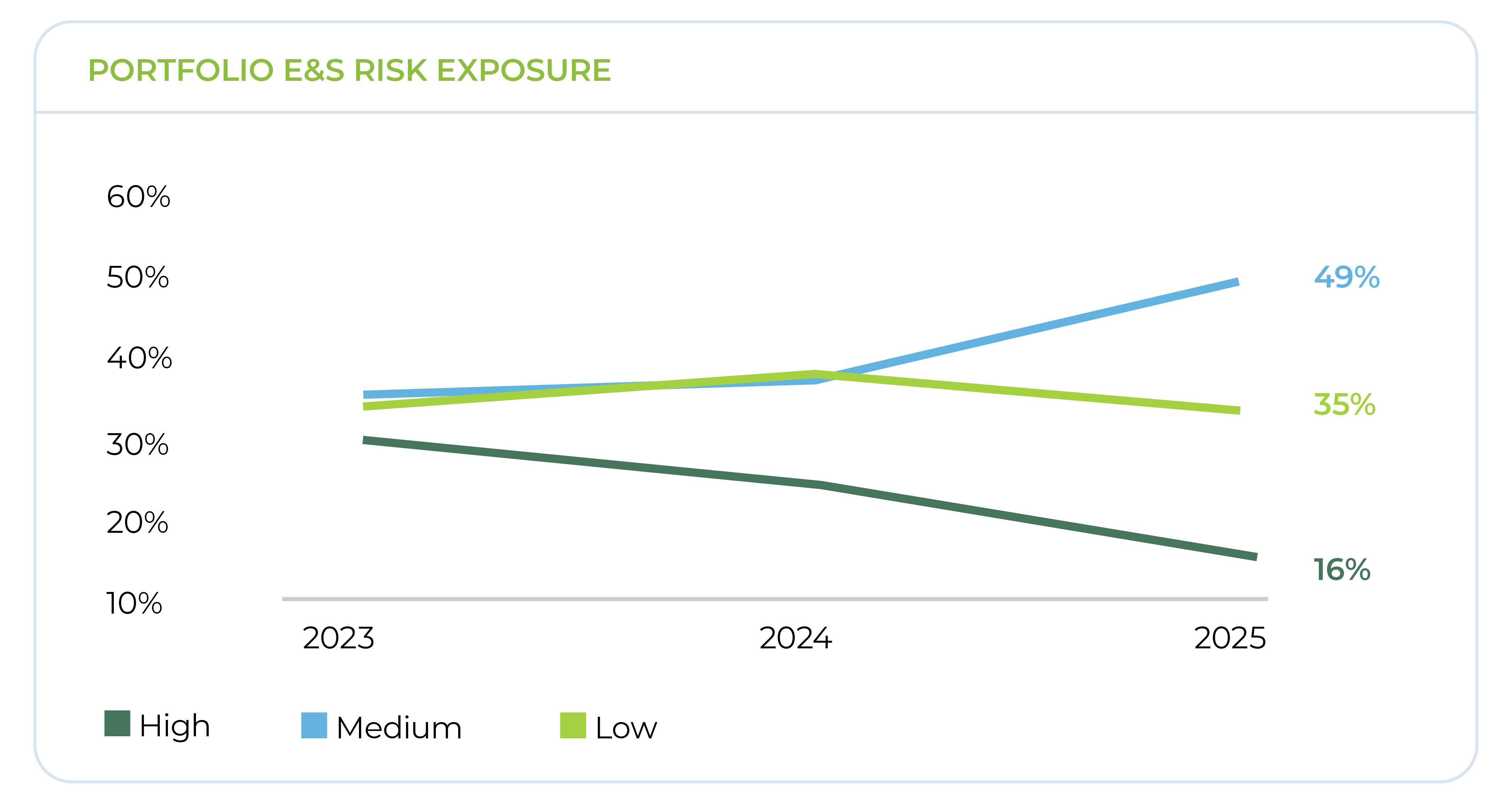
Portfolio risk mix improved, with high-risk exposures declining to 16% and a higher share of medium-risk assets at 49%, reflecting disciplined risk management.
Sustainable Finance strategy and performance
Security Bank’s Sustainable Finance Framework guides the identification, selection, and reporting of eligible sustainable finance projects and instruments, including green, social, and sustainability bonds, loans, deposits, and other instruments. Eligible projects are aligned with recognized national and international standards.
As of 2025, the Bank has disbursed PHP107.76 billion to green and social projects, a 38% increase from 2024. Of this:
- PHP75.8 billion supports green finance
- PHP31.9 billion supported social development initiatives
- This exceeded the Bank’s 2023 commitment to double its sustainable finance portfolio by 2025 by 24%, underscoring strong momentum in responsible financing.
Environmental performance
Operational emissions primarily arise from the Bank’s day-to-day activities, including energy use in offices and branches, mobile combustion, other fuel and energy-related activities, and employee travel for business development and client engagements. Security Bank calculates operational emissions in accordance with the GHG Protocol, applying dual reporting, and the best practice in GHG accounting.
The Bank initiated its Scope 3 Financed Emissions Inventory in 2023 and continued to advance this work in 2025, enhancing data quality and embedding emissions measurements across the organization. In 2025, the inventory was prepared following the Partnership for Carbon Accounting Financials (PCAF) methodology, using a control approach to define system boundaries across all entities under Security Bank’s operational control.

Social performance
Our Human Capital Management (HCM) initiatives focused on helping employees work smarter by reducing administrative friction and strengthening the tools that support their work. By simplifying processes and investing in digital platforms, we enabled our people to focus more on meaningful work, collaboration, and development.
The Bank’s social initiatives focus on people—employees, customers, and communities. Efforts centered on employee wellbeing and capability building, financial inclusion, and supporting MSMEs through access to finance and advisory support.
UN SDG alignment
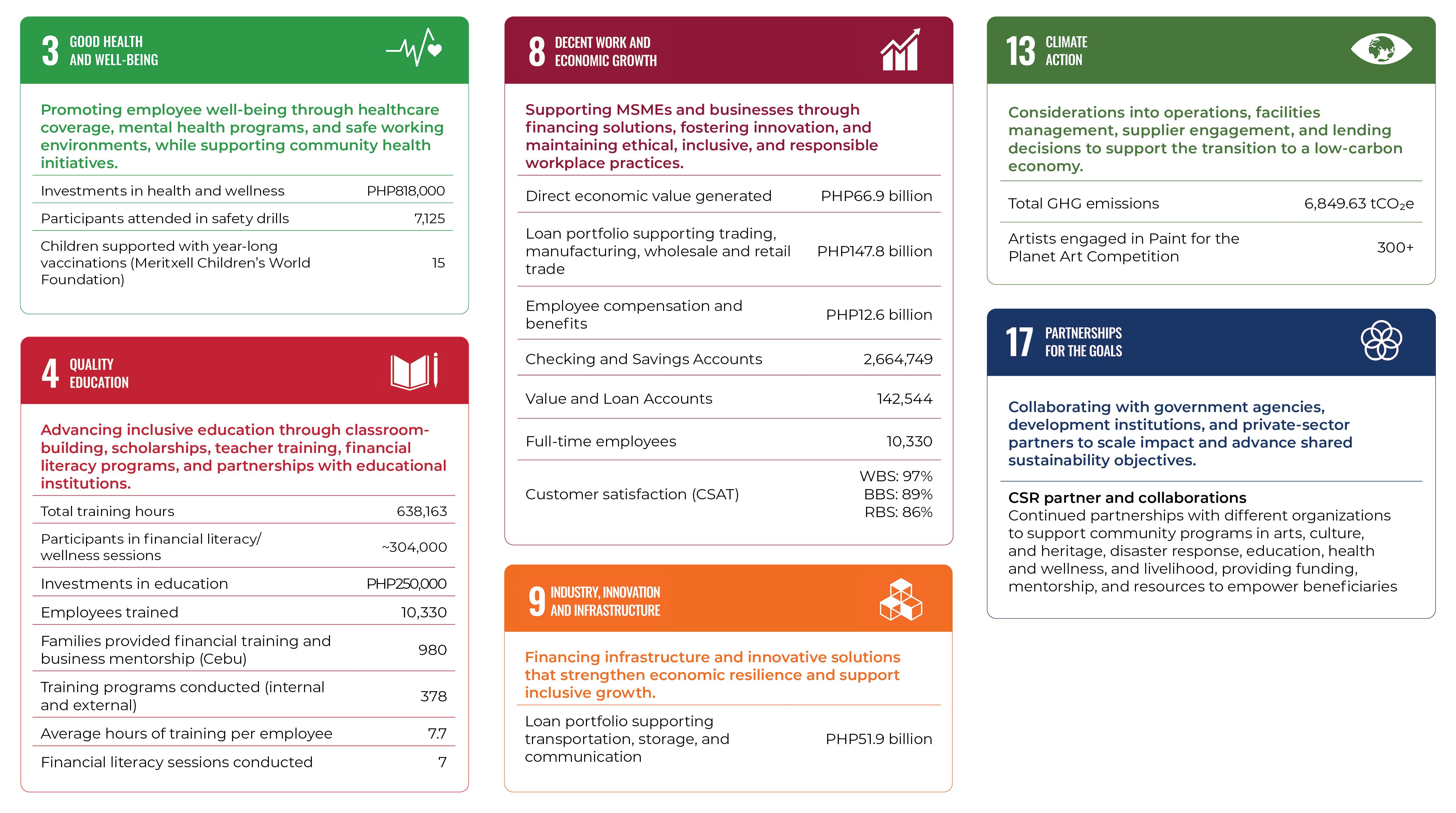
Security Bank contributes to the United Nations Sustainable Development Goals (UN SDGs) by focusing on areas where our core banking capabilities can deliver the greatest impact. While our activities support all 17 SDGs, we prioritize those aligned with our strategy and national development priorities. These priority SDGs are integrated into our sustainability goals and performance indicators, ensuring alignment between global development priorities and our material focus areas to support long-term value creation.
ESG credibility and disclosure
The Bank’s sustainability performance and disclosures align with leading global frameworks, including GRI Standards, SASB, and IFRS Sustainability Disclosure Standards. In 2025, Security Bank maintained an MSCI ESG Rating of A (as of March 23, 2026), reflecting disciplined governance and integrated ESG execution.
2025 Integrated Report
Please wait while flipbook is loading. For more related info, FAQs and issues please refer to DearFlip WordPress Flipbook Plugin Help documentation.